

Clinical Research Trials Bring Innovative Women’s Healthcare to Southern Nevada
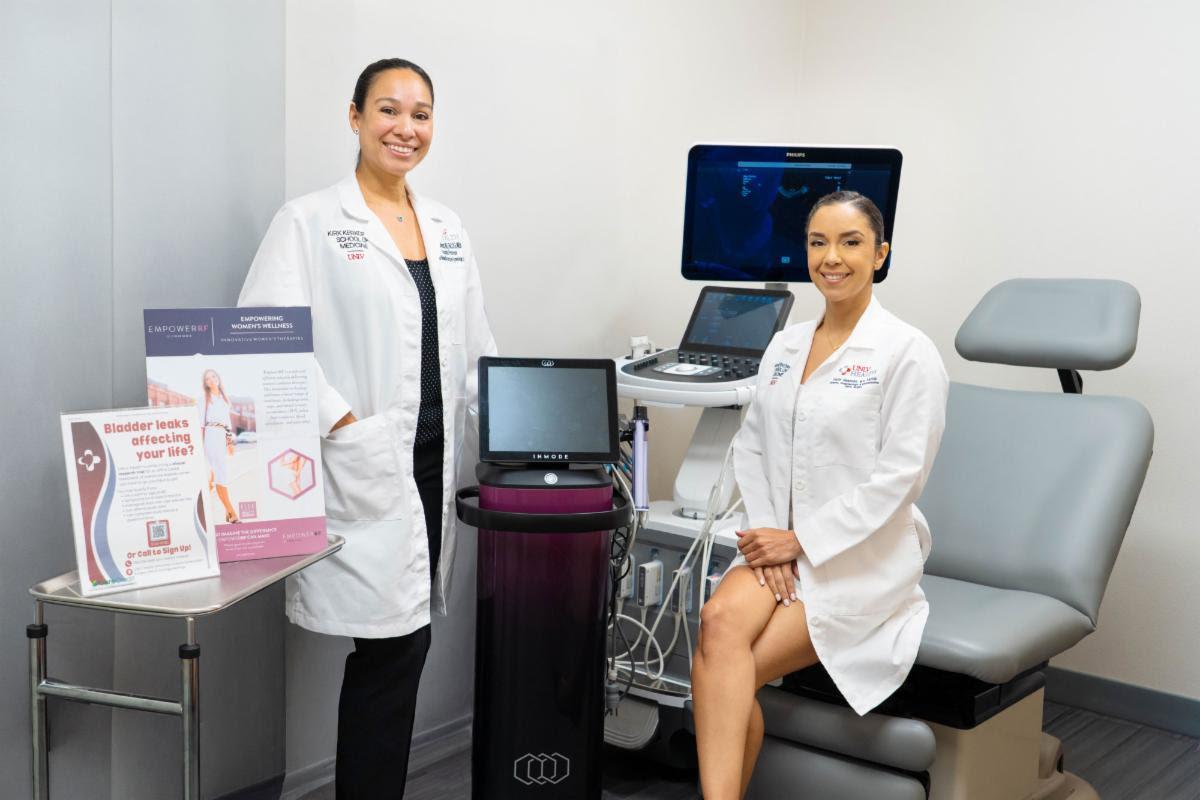
Two national studies led locally by UNLV Health physicians expand options for patients while raising the profile of the Kirk Kerkorian School of Medicine at UNLV as a center for clinical research.
Two clinical trials advancing women’s health are bringing national attention to the Kirk Kerkorian School of Medicine at UNLV — and to its mission of increasing the number of physicians and medical specialists serving Nevada.
Led locally by Drs. Nadia Gomez and Yarini Quezada of the department of gynecologic surgery & obstetrics, the studies demonstrate how recruiting specialists, conducting clinical research, and introducing new treatments can help more patients receive advanced care without leaving the state.
“We know that we do have the powerhouse here, and patients don’t have to leave the state,” Quezada said. “There’s just not enough awareness in the community.”
Quezada, an assistant professor and division director of urogynecology and reconstructive pelvic surgery, said she and Gomez have encountered patients who believed they needed to travel to California or Arizona for specialized care.
“We’re trying to change that narrative,” Gomez said.
A New Approach to Overactive Bladder
The first study, the DENARA clinical trial, is evaluating whether a microneedling device can help women with overactive bladder, a condition characterized by a difficult-to-control need to urinate. Patients may also experience frequent urination, nighttime waking, and urinary incontinence.
European studies found that stimulating the anterior vaginal wall with microneedles improved overactive bladder symptoms, leading researchers to test a modified device in the current study.
The randomized, double-blind study is being conducted at five institutions, including UNLV, Stanford, and the University of Chicago, with Quezada and Gomez serving as UNLV’s principal investigators.
The office-based procedure takes less than five minutes under local anesthesia. Participants complete follow-up visits, questionnaires, and a bladder diary over approximately 18 months. UNLV is seeking toenroll 30 women ages 22 to 80 who experience urge incontinence.
Quezada said participating in the study places UNLV among a group of institutions offering patients access to the experimental treatment.
“It’s a great platform for UNLV to be involved in clinical research that is nationwide,” she said. “It has the potential to revolutionize medicine in the women’s health space while putting UNLV on a national stage.”
A Smaller Surgical Robot
A second clinical trial, completed in December 2025, evaluated the MIRA Surgical System for benign hysterectomies.
MIRA is a miniaturized robotic-assisted surgery system designed to provide some of the benefits of larger robotic platforms while requiring less operating-room space. The system uses a single incision, and its reusable components fit inside a standard surgical tray.
The system had previously received Food and Drug Administration (FDA) authorization for use in colon surgery. In August, the FDA cleared MIRA for use in benign hysterectomy procedures following a national study involving five surgeons at three hospitals.
UNLV was one of those three participating institutions and enrolled 13 patients in the trial.
Gomez, associate professor and vice chair of the department of gynecologic surgery & obstetrics and interim vice dean for clinical affairs, said minimally invasive robotic surgery can result in less pain, reduced blood loss, and faster recovery than traditional open abdominal surgery.
That work has earned Gomez recognition. Nevada Business Magazine named her the Southern Nevada honoree in the Innovator category of its 2026 Healthcare Heroes awards, citing her leadership in the MIRA clinical trial.
The MIRA system could also make robotic surgery available to hospitals unable to afford or accommodate a larger platform. Its manufacturer is now developing a second-generation model intended to further reduce the size of the incision required.
The UNLV portion of the hospital-based trial was made possible through the medical school’s partnership with the University Medical Center of Southern Nevada (UMC).
“Without that partnership, we can’t do a hospital-based surgical clinical trial,” Gomez said. “It is extremely important and we are grateful for their partnership.”
Building a Research Institution With Our Academic Physicians
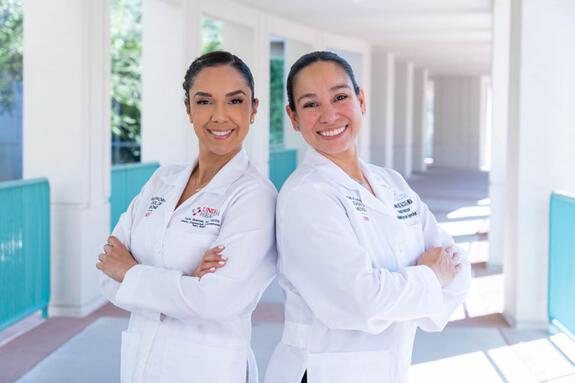
These clinical research trials represent another step in the development of the medical school’s clinical-research portfolio. UNLV holds the Carnegie Classification’s R1 designation, the highest classification for doctoral research universities and one that signifies very high research activity.
“When sponsors come to our sites, they’re evaluating the expertise of our clinical faculty, their access to eligible patients and the research infrastructure that we have built,” says Michelle Tomasino, director of the office of clinical trials. “Being chosen demonstrates growing confidence in UNLV’s capabilities and reputation. It also validates the clinical research infrastructure we’ve spent almost a decade building here at the school of medicine.”
That growing research profile can also help the school attract academic physicians and specialists who want to combine teaching and clinical patient care with opportunities to be involved with emerging treatments. In turn, those academic physicians train future Nevada physicians and broaden the care available to Southern Nevada residents.
“It allows our medical students and residents to learn how evidence-based medicine is created and how to conduct research appropriately,” Tomasino said. “They’re also gaining experience in research ethics and patient safety. It keeps talented clinicians in the state.”
For Gomez and Quezada, the ultimate goal is to ensure that medical innovation and evidence-based care reaches the community the school was established to serve.
“We’re conducting state-of-the-art research and using modern technology,” Quezada said. “We have the ability to offer that to our patients locally, so they do not have to leave the state.”